
Your organisation's knowledge exists. The system that makes it instantly usable does not.
Retrieval-augmented generation and knowledge base AI for call centres and back office operations. Grounded answers from your own knowledge. Consistent, traceable, and current. Built for production.
THE PROBLEM IT SOLVES
The knowledge exists. Reaching it is the problem.
Every organisation with a call centre or a back office team has the same problem. The knowledge exists, in documents, in systems, in the heads of the people who have been there longest. But accessing it is slow, inconsistent, and dependent on who you ask.
A new agent takes months to reach the same answer quality as an experienced one. An experienced agent searches three systems to answer one question. A policy changes and half the team does not know yet.
A knowledge base built on RAG and a graph layer changes that. The agent asks a question in natural language. The system retrieves the right answer from the organisation's own knowledge, grounded in real documents and real relationships. Consistent. Traceable. Current.
HOW IT WORKS
Five steps. Documents in, grounded answers out.
FIG · 01 · THE KNOWLEDGE BASE FLOW
-
01 · Ingestion
Documents, policies, procedures, and structured data enter the pipeline. The content is processed, chunked, and prepared.
-
02 · Entity and relationship extraction
Entities are identified. Relationships between them are mapped. The knowledge is no longer a pile of documents. It is a structured map of what the organisation knows.
-
03 · The two storage layers
The vector layer stores semantic representations for broad retrieval. The graph layer stores entities and relationships for precise, context-aware answers. LightRAG combines both.
-
04 · Retrieval and grounding
A query arrives. The system retrieves the most relevant content from both layers. The model generates an answer grounded in that retrieved content, not in general training data.
-
05 · The answer
Consistent. Traceable back to the source document. Current as of the last ingestion run.
FIG · 02 · KNOWLEDGE GRAPH EXAMPLE
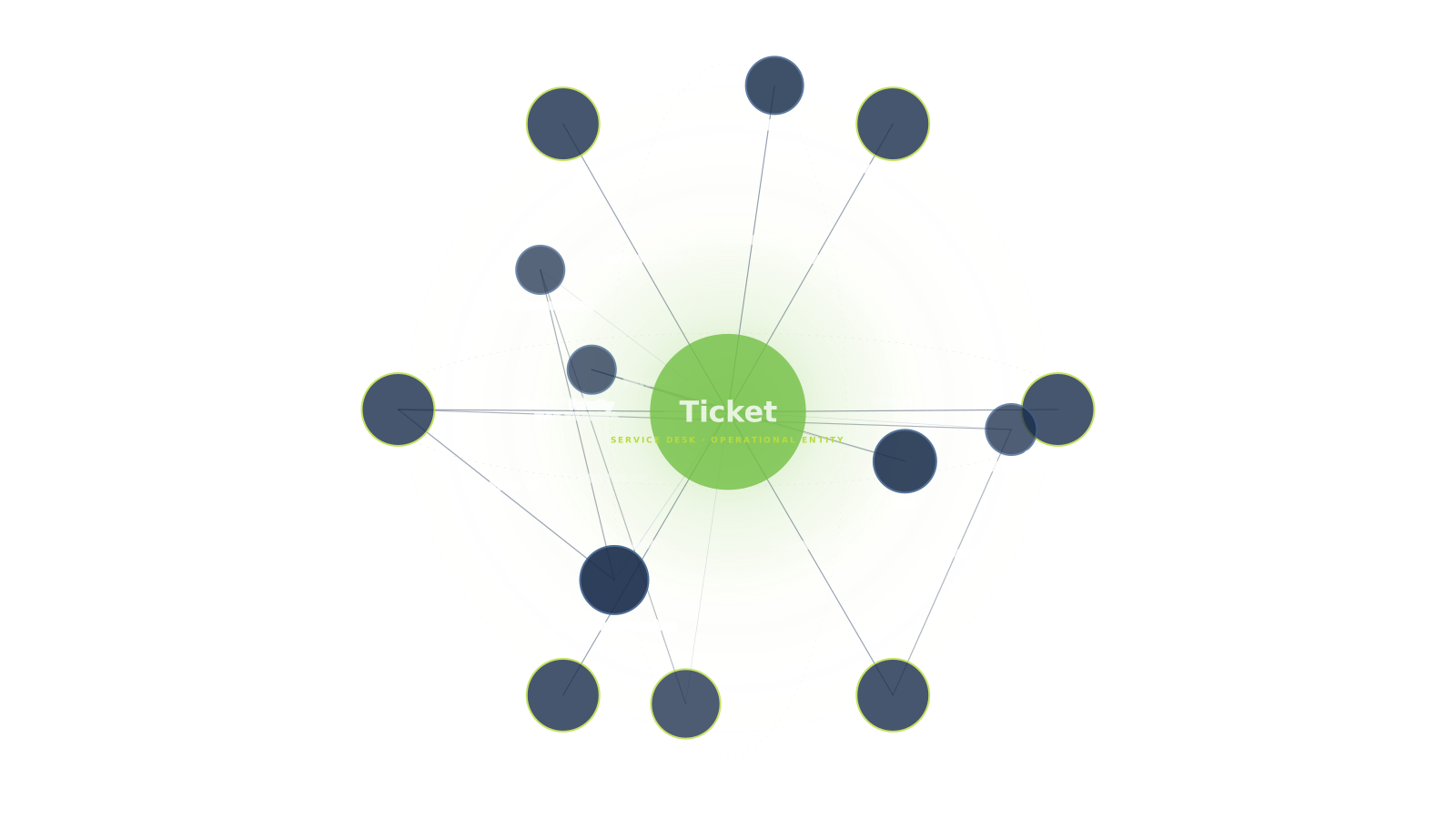
What step 03 produces. A queryable structure of entities and relationships. The hub holds the canonical source of truth. Satellites carry the context that turns a generic answer into a grounded one.
This is not an AI that guesses from training data. It is an AI that retrieves from your knowledge and answers from what it finds.
THE TECHNOLOGY
What it is built on.
-
LightRAG
Combines vector search and graph-based retrieval for answers that are more accurate on complex, interconnected knowledge than vector search alone. The right tool for knowledge bases where relationships between entities matter.
-
Vector databases
Pinecone and equivalent. The semantic search layer that retrieves broadly relevant content before the graph layer refines it.
-
The ingestion pipeline
Documents in, structured knowledge out. Designed to run continuously so the knowledge base stays current as the organisation's knowledge changes.
-
Model-agnostic retrieval
The knowledge base is built to work with any model. The retrieval layer is independent of the generation layer. When a better model appears, the knowledge base does not need to be rebuilt.
THE FOUNDATION
Every knowledge base engagement ships with the same operational baseline.
Each engagement inherits what it requires. EU hosting is the default. The cryptographic audit trail comes on for regulated work. The SLA comes on where uptime is the commitment. The rest is standard.
-
EU hosting as standard
The organisation's knowledge stays in the EU. On-premise deployment supported where the regulatory context requires it.
-
Access control
Who can query what. Enforced at the knowledge base level, not just at the application layer.
-
Cryptographic audit trail
Where the engagement calls for it, every query and every retrieved source is logged and traceable.
-
GDPR compliance
The ingestion pipeline and the knowledge base are designed to meet regulatory requirements from the start.
-
Monitoring
Retrieval quality and system health are watched. Degradation surfaces before it affects the people relying on the system.
-
SLA
Service level agreements available on all engagements, subject to separate arrangement.
HOW IT CONNECTS
A knowledge base rarely runs alone.
-
Data engineering and pipelines
The data layer that feeds the knowledge base. Clean, well-structured data is what makes retrieval accurate.
-
AI orchestration
The knowledge base is one component in a larger AI system. The orchestration layer manages the retrieval, the model, the HITL gates, and the logging.
-
Agentic systems
Agents that need to reason over organisational knowledge draw on the knowledge base as their ground truth. The two are designed to work together.
Tell us where your organisation's knowledge is and what it needs to do.
We will tell you what the knowledge base would look like and what it would take.
COMMON QUESTIONS
Asked before starting.
-
What is RAG?
RAG stands for Retrieval-Augmented Generation. Instead of relying on what a model was trained on, the system retrieves relevant information from the organisation's own knowledge base at the moment of the query, and grounds the model's answer in that retrieved content. The result is accurate, traceable answers from your own knowledge rather than generic model output.
-
What is the difference between a vector database and a knowledge graph?
A vector database stores documents as mathematical representations and retrieves the ones most similar to a query. A knowledge graph stores entities and the relationships between them. LightRAG combines both layers: vector search for broad retrieval, graph traversal for precise relationship-aware answers. The combination produces significantly more accurate results for complex, interconnected knowledge.
-
How is this different from just uploading documents to an AI?
Uploading documents gives a model unstructured text to search through. A knowledge base built on RAG and a graph layer structures that knowledge: entities are extracted, relationships are mapped, and retrieval is precise. The difference shows in the answers: consistent, grounded, traceable rather than approximate and unverifiable.
-
Can the knowledge base be updated as the organisation's knowledge changes?
Yes. The ingestion pipeline is designed to keep the knowledge base current. New documents, updated policies, changed procedures, the pipeline processes them and the knowledge base reflects the change. The model always answers from current knowledge.
-
Is the data kept within the EU?
Yes. EU hosting is the standard. On-premise deployment is supported where the regulatory context requires it. The organisation's knowledge stays where it belongs.
-
Is an SLA available?
Yes. Service level agreements are available on all RAG and knowledge base engagements, subject to separate arrangement.